Understanding Water Heater Expansion Tanks in Kansas City Homes
Learn why Kansas City homes need water heater expansion tanks, how thermal expansion causes pressure spikes, and signs of a failing bladder tank.
Need a Plumber in Kansas City, MO?
Plumbing Problem? Call for professional plumbing help.
Get help with emergency plumbing, clogged drains, leaking pipes, water heaters, burst pipes and other residential plumbing problems in Kansas City, Missouri.
Need a Plumber in Kansas City, MO?
Plumbing Problem? Call for professional plumbing help.
Get help with emergency plumbing, clogged drains, leaking pipes, water heaters, burst pipes and other residential plumbing problems in Kansas City, Missouri.
The Mechanics of Thermal Expansion in Closed Plumbing Systems
Water expands in volume by roughly two percent when heated from cold incoming temperatures to standard domestic storage temperatures of 120°F to 140°F inside a water heater. In open municipal water systems of the past, this excess volume simply pushed backward through the municipal supply line and dissipated into the city water main. However, modern Kansas City municipal codes—and the installation of backflow prevention devices, dual-check valves, and pressure reducing valves (PRVs) at the meter—turn residential plumbing into a strictly closed system. With nowhere for the thermally expanding water to go, static pressure spikes dramatically inside the water heater tank and household piping every time the burner or element fires up.
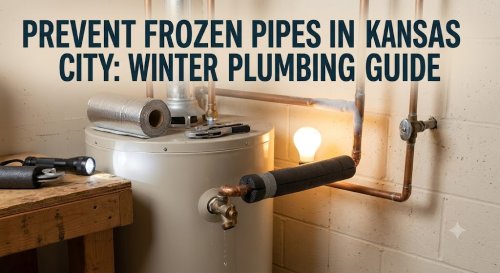
A water heater expansion tank acts as a hydraulic shock absorber for this exact thermodynamic phenomenon. Located on the cold water supply line above or near the water heater, the tank contains a heavy-duty rubber bladder separating an upper air chamber (pre-charged to match the home's incoming water pressure) from the lower water chamber. As the water heats up and expands, it pushes up against the flexible bladder, compressing the pressurized air pocket above it and absorbing the excess volumetric displacement without elevating overall system pressure.
Distinguishing Fixture-Specific Pressures from System-Wide Spikes
Homeowners often confuse high static water pressure caused by a failing municipal pressure reducing valve with pressure spikes generated by thermal expansion. Diagnostic boundaries are clear: if your water pressure is consistently high at all times of the day—regardless of whether the water heater is actively heating—the issue stems from the main service line PRV. If the pressure spike occurs exclusively during or immediately after the water heater cycles on, or if the Temperature and Pressure (T&P) relief valve drips intermittently, the issue is thermal expansion and a compromised or missing expansion tank.
Overlooked Trade Secrets: Why Kansas City Homes Suffer Expansion Failures
Kansas City residential infrastructure features unique geological and municipal traits that accelerate expansion tank wear. The local water supply, managed by Kansas City Water Services and various Johnson County districts, arrives with varying mineral content and dynamic pressure swings. When summer droughts cause the heavy, expansive clay soils throughout Overland Park, Olathe, and Midtown to shrink and shift, underground service lines flex. This movement occasionally damages older curb-stop valves and PRVs, forcing homeowners to install new backflow devices that instantly seal their home plumbing into a closed loop.
Another overlooked trade secret involves the pre-charge pressure of the expansion tank itself. Many DIY installations fail because the installer mounts the tank straight out of the box without matching the tank's air pre-charge (typically set to 40 PSI at the factory) to the home's actual static water pressure (which often runs between 60 to 80 PSI in elevated Kansas City pressure zones). If the air charge is lower than the water pressure, water completely fills the tank immediately, leaving no air cushion to absorb thermal expansion, which rapidly degrades the rubber internal diaphragm.
Static Pressure Versus Dynamic Flow Rate
When evaluating a closed water system, plumbers measure static pressure (PSI when no fixtures are running) against dynamic flow rate (PSI drop when multiple fixtures open simultaneously). A failing or water-logged expansion tank will cause static pressure spikes to exceed 100 PSI during heating cycles, prematurely wearing out washing machine hoses, ceramic cartridge faucets, and toilet fill valves across the entire home.
Safe Homeowner Triage Versus Dangerous DIY Boundaries
Homeowners can safely perform routine diagnostic checks on their water heating systems without risking property damage or personal injury. However, strict boundaries apply when dealing with pressurized vessels and high-temperature water.
- Safe Homeowner Step: Inspect the air valve (resembling a standard tire Schrader valve) on top of the expansion tank. By firmly pressing the valve pin for a split second, you can check if water spurts out. If water escapes through the air valve, the internal bladder has ruptured, and the tank is water-logged and completely dead.
- Safe Homeowner Step: Monitor your water meter during a period of zero household usage while the water heater is heating. A creeping meter dial indicates that expanding water is forcing its way backward past worn check valves or causing relief valves to weep.
- Dangerous DIY Boundary: Never attempt to adjust, unthread, or plug a dripping T&P relief valve on the side of the water heater tank. If the relief valve is discharging, it is doing its job of venting dangerous over-pressure; capping it off transforms the water heater into an unvented pressure vessel with explosive potential.
- Dangerous DIY Boundary: Avoid unthreading heavy steel expansion tanks from pressurized copper or PEX supply lines without first shutting off the cold water supply and completely draining the system pressure. Torsional strain on old, corroded nipples can snap fittings and flood a basement.
Realistic Repair Approaches and Decision Support
When an expansion tank fails, repair is impossible; total replacement is required. Evaluating the correct replacement path depends on several local factors common to the Kansas City metro area, including basement clearance, local municipal plumbing codes, and the age of the connected water heater.
In older homes throughout historic neighborhoods like Brookside and Westport, water heaters are frequently crammed into low-clearance basement corners or tight utility closets. Upgrading to a properly sized thermal expansion tank often requires reconfiguring old galvanized or rigid copper drop lines to accommodate the weight of the new tank, as local building codes strictly prohibit supporting a water-filled expansion tank solely by a thin copper pipe without a secure mounting bracket or structural strap.
| Symptom | Probable Root Cause | Recommended Action |
|---|---|---|
| Water drips continuously from the T&P relief drain pipe | Failed expansion tank bladder or incorrect air pre-charge in a closed system | Test air valve; replace expansion tank and match pre-charge to static line pressure. |
| Expansion tank feels completely heavy and water-logged from top to bottom | Ruptured internal diaphragm allowing water to flood the air chamber | Disconnect and replace the expansion tank immediately to prevent water heater tank fatigue. |
| Water spurts from the Schrader air valve when depressed | Total bladder failure | Install a new expansion tank rated for the exact gallon capacity of the water heater. |
| Banging or thumping noises (water hammer) in pipes when valves snap shut | High system pressure or lack of shock arrestors combined with thermal expansion | Check municipal PRV setting, test expansion tank, and install dedicated hammer arrestors. |
Frequently Asked Questions
Are expansion tanks legally required on all Kansas City water heaters?
Yes. Municipalities across the Kansas City metropolitan area enforce the International Plumbing Code (IPC) and Uniform Plumbing Code (UPC), both of which mandate thermal expansion control whenever a closed-loop system is created by backflow preventers or pressure reducing valves.
What size expansion tank do I need for a standard 50-gallon residential water heater?
Most standard residential water heaters ranging from 40 to 50 gallons require a standard 2-gallon expansion tank (such as a thermal expansion vessel designated for residential sizing). Larger homes, tankless systems with recirculation loops, or high-capacity 75-gallon tanks require larger expansion vessels calculated based on total system volume and incoming water pressure.
Can I install a water heater expansion tank horizontally?
While expansion tanks can be installed horizontally, manufacturers strongly recommend vertical installation with the tank pointing upward. Mounting a heavy water-filled tank horizontally puts excessive bending stress on the pipe fittings unless the tank is structurally supported by a rigid wall bracket.
How long does a typical thermal expansion tank last?
The average lifespan of a residential expansion tank is 5 to 8 years. The flexible rubber bladder inside degrades over time from constant flexing and exposure to mineral-rich municipal water. Once the bladder cracks, the tank loses its air cushion and fails completely.
What happens if I operate a water heater without an expansion tank in a closed system?
Without an expansion tank, thermal expansion creates extreme pressure spikes that weaken the glass-lined steel tank of the water heater, rupture appliance hoses, destroy plumbing fixture cartridges, and cause the T&P relief valve to constantly dump scalding water.
Share

Plumber in Kansas City