How to Shut Off Your Kansas City Home’s Main Water Supply
Learn exactly how to locate and shut off the main water supply in your Kansas City home. Our practical plumbing guide saves you from water damage

Need a Plumber in Kansas City, MO?
Plumbing Problem? Call for professional plumbing help.
Get help with emergency plumbing, clogged drains, leaking pipes, water heaters, burst pipes and other residential plumbing problems in Kansas City, Missouri.
Need a Plumber in Kansas City, MO?
Plumbing Problem? Call for professional plumbing help.
Get help with emergency plumbing, clogged drains, leaking pipes, water heaters, burst pipes and other residential plumbing problems in Kansas City, Missouri.
How to Shut Off the Main Water Supply in a Kansas City Home
A massive water leak is arguably the most destructive emergency that can hit your Kansas City home. The frantic search for the main water supply shut-off is a scenario every professional plumber in Kansas City has encountered—often after the damage is already severe.
When a pipe bursts during a deep Missouri freeze, or a washing machine hose splits, water can release at full residential pressure—dozens of gallons every minute. The destruction to floors, drywall, and ceilings happens rapidly. Homeowners commonly search for this topic during a crisis, but finding and knowing how to shut off the main water supply in your Kansas City home before an emergency strikes is critical for water damage prevention. This proactive step can save you thousands of dollars in restoration and costly structural repairs. This isn't generic advice; it's a practical safety skill tailored to the standard home designs found throughout the Greater Kansas City area.
What Is Your Main Water Supply Shut-Off?
Your home’s main water shut-off is a single valve that controls all the pressurized fresh water entering your residential plumbing system. This is the master switch for your water.
Definition and Function
Think of this valve as the dam gate for your home. When open, it allows water from the municipal water grid—serviced by Kansas City Water or nearby water districts—to flow into every faucet, shower, toilet, and water heater. When closed, it physically blocks that flow, depressurizing your system (once downstream faucets are opened) and stopping any leak or disaster from worsening.
Common Valve Types in Kansas City Homes
Plumbing installations in KC utilize two primary types of main valves:
1. Ball Valves
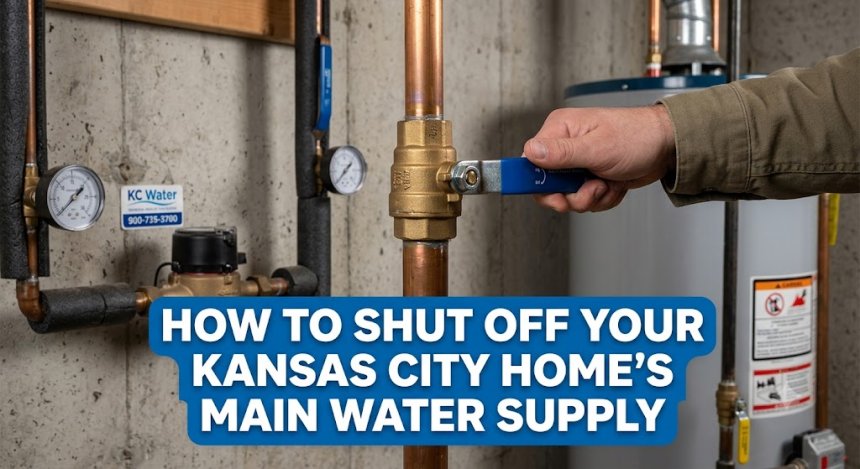
This is the modern standard and the preferred type for a reliable shut-off. A ball valve features a simple handle. When the handle is aligned parallel to the pipe, the water is flowing (OPEN). To shut it off, you simply turn the handle 90 degrees until it is perpendicular to the pipe (CLOSED). Inside the valve, a sphere with a hole through it rotates to block the flow.
2. Gate Valves
Common in older Kansas City residences, particularly those built before the 1980s, these valves use a round wheel handle, similar to a hose spigot. Inside, turning the wheel handle raises or lowers a internal metal "gate" to block the flow. These require multiple turns to close and are notoriously prone to failing open or locking up over time. If your main is a gate valve, exercising it regularly is crucial.
Why You Need to Know Its Location
Waiting for an emergency plumber to arrive while water is actively flooding your basement or living room is a disaster. Every minute that water flows uncontained, the restoration cost skyrockets. Knowing the exact location of your shut-off valve gives you instant containment, changing a catastrophic water disaster into a manageable plumbing repair.
Common Causes of Sudden Pipe Burst Emergencies
Why do pipes suddenly fail, forcing you to use your main shut-off? It is almost always a combination of environmental stress and system decay:
[Freeze-Thaw Cycles] ──> [Hydraulic Pressure] ──> [Pipe Rupture (Standard in KC Winter)]

[Aging Metal Pipes] ──> [Pinhole Leaks/Weak Joints] ──> [Sudden Catastrophic Failure]

[High Water Pressure] ──> [Continuous System Stress] ──> [Valve or Joint Failure]
-
Seasonal Weather (Frozen Pipes): This is the number one cause of winter emergencies across the Kansas City metro. Supply lines running through unheated crawlspaces, exterior walls, or attached garages are particularly vulnerable. As water freezes, it expands with immense force. It doesn't just create a blockage; the hydraulic pressure builds between the ice and closed faucets, eventually causing the pipe wall—whether copper, PEX, or old galvanized steel—to split. When that ice thaws, full line pressure releases uncontained.
-
Corrosion and Aging Pipes: Many older homes (historic Northeast, Waldo, Brookside) still use original galvanized iron piping. Over 50+ years, this material rusts internally. This corrosion weakens the pipe walls and restricts flow until a small vibration or pressure change causes a massive failure, often at a weak joint.
-
High Water Pressure: Municipal water pressure fluctuatues. A faulty main line pressure-reducing valve (PRV) can let municipal pressure above 80 PSI surge into your home’s plumbing. Constant high pressure stresses every connection, fitting, and valve in your house, making a burst exponentially more likely.
-
Hard Water Deposits: Kansas City water varies in mineral content, but hard water causes scale buildup inside pipes. This scale restricts water flow, reduces appliance efficiency, and can actually corrode certain pipe materials or seize vital valves (like your main shut-off) over time.
Signs You Should Never Ignore: Warning Indicators of a Severe Plumbing Failure
Plumbing systems rarely fail without warning. The vast majority of emergency calls in Kansas City could have been a simple, scheduled plumbing repair if the homeowners hadn't ignored these signs:
| Warning Sign | Why It Matters (The Real Risk) |
| New or Spreading Water Stains (Ceiling/Wall) | Active water is leaking behind your finished surfaces. By the time you see a stain, significant damage, structural rotting, and mold growth have likely already started. Immediate leak detection is necessary. |
| A Drastic and Sudden Drop in Water Pressure | This is the signature sign of a massive leak, likely a main water line break under your slab foundation or near the street. Water is escaping unmanaged somewhere. |
| Rattling or Banging Pipes ("Water Hammer") | Secure pipe strapping is failing, or you have high water pressure. Constant vibration weakens fittings over time until they suddenly fail completely. |
| Musty Smells and Visible Mold Growth | Water leaks breed mold quickly. Mold indicates that moisture has been present for days, meaning hidden damage is likely already severe. |
| A Spinning Water Meter (With All Taps Closed) | Your meter is actively registering water use. If you are not intentional using it, it is leaking—potentially in a slab or underground line where you cannot see it. |
| Water Marks Around the Water Heater Base | The tank is rusting through, or a vital relief valve is failing. A full tank failure can dump 40-50 gallons of water in minutes. |
| A Continuously Running Toilet | While it seems minor, a single running toilet can waste over 10,000 gallons of water a month, leading to an incredibly high utility bill. |
Step-by-Step Professional Leak Detection & Repair Process
When you call a reputable Kansas City plumber like our team to handle a mysterious leak, we follow a methodical process. This transparency is crucial before you hire anyone:
-
Step 1: Emergency Shut-Off and Stabilizing Our first priority upon arrival is always stabilization. We turn off the main water shut-off (if you couldn't) to stop all damage. If your main valve is broken, we contact the municipal water utility (KC Water, etc.) to shut the water off at the meter pit in the yard, which requires specific utility tools (called a water key).
-
Step 2: Diagnostic Inspection and Evaluation We inspect the visible plumbing system for symptoms of a leak.
-
Step 3: Honest, Upfront Estimate Reputable contractors always provide a detailed, written estimate before starting any work. This document explains the proposed repair, the materials required, the expected labor time, and any permit costs. We will break down your options, such as replacing a specific section versus a more comprehensive re-pipe.
-
Step 4: Safe, Controlled Repair or Replacement We cut out the damaged section and replace it using code-compliant materials, such as copper or flexible PEX piping, making secure, permanent connections. We adhere strictly to Kansas City building codes.
-
Step 5: Rigorous Pressure Testing Before we "turn the water back on," we must pressure test the system. This involves either hydro-static testing or air-pressure testing on the isolated repair section (or the whole house) to ensure there are zero pinholes or joint leaks. We slowly depressurize to avoid shocking the system.
-
Step 6: Site Cleanup Plumbing work is destructive. A true professional cleans the immediate work area, removing damaged pipe and debris, and leaves the area ready for structural dry-out or repair (which requires specialized water restoration services).
-
Step 7: Proactive Winterization Advice After fixing a freeze-burst, we look for the why. We check water pressure and examine existing insulation, giving you specific recommendations (like heat tape or added insulation) to prevent a recurrence.
How to Find and Shut Off Your Kansas City Home's Main Water Valve
Ready to locate your master valve? In the Kansas City area, residential valves follow common placement patterns:
                  +-----------------------------------+
                  | Main Shut-Off Valve Locations (KC)|
                  +-----------------------------------+
                                    |
   +--------------------+-----------+-----------+--------------------+
   |                    |                       |                    |
   v                    v                       v                    v
[Basement]          [Crawlspace]        [Utility Room]      [Outdoor Meter Pit]
Near Front Wall     Near Foundation     By Water Heater     Near Curb (KC Water)
1. The Basement (The Most Common in KC)
In homes with basements, the main water service line typically enters the foundation wall on the street-facing side. Look within 2-3 feet of where the concrete wall meets the floor, often near the corner. The valve will be located on this pipe, typically immediately before (or after) the interior water meter.
2. The Crawlspace
In homes built over a crawlspace, the main valve will still be near where the water line enters. Unfortunately, this is often in the least accessible part of the crawlspace, near the front of the home. This placement is incredibly vulnerable, as freezing air drafts commonly sweep through crawlspaces.
3. The Utility Room or Garage
In slab-on-grade homes (which are becoming more common in newer KC suburbs), the water main line may rise through the floor in a utility closet, near the furnace, or within an attached, potentially unheated garage.
4. Draining Your Whole Home's Water Plumbing System
Once you have shut off the main valve to stop a leak, you must then open a faucet at the lowest level of your home (often a basement slop sink) and the highest level (like an upstairs master bath) simultaneously. This vents the system, allowing the standing water trapped inside the lines to drain out safely. This prevents residual pressure from pushing water through a burst.
5. When You Cannot Find the Main Interior Water Supply Valve
If you simply cannot find an interior shut-off, or if it is completely seized and will not move, you must shut off the water at the city water meter. This is almost always located in a concrete pit near your front curb, covered by a heavy iron lid.
Tools You Might Need for Your Kansas City Home’s Main Valve
You do not need an industrial toolbox, but having a few specific items ready makes a world of difference:
-
A High-Quality Flashlight: A reliable, durable light source is non-negotiable for finding valves in dark crawlspaces, basements, or outdoor pits.
-
A Sturdy Set of Pliers or a Wrench: A crescent wrench or adjustable pliers provide necessary leverage, especially for stuck or corroded gate valve wheel handles.
-
A "Water Meter Key" (or Water Utility Wrench): Every Kansas City homeowner should own this simple tool. It is a T-shaped steel wrench designed specifically to fit into the rectangular operating nut of the city water shut-off valve located inside your curb-side meter pit. It can turn the water off for your entire house, bypassing a failed or hidden interior main valve.
-
A Tire Pressure Gauge: A simple, cheap gauge is crucial for monitoring your household's active water pressure (screwing onto any standard hose spigot). Ensuring your pressure is between 50-70 PSI significantly extends the lifespan of your plumbing.
Cost Factors for Main Shut-Off Valve Services
Plumbing repair costs vary depending on the severity of the problem, accessibility, materials required, emergency service, property type, and local labor rates. A reputable contractor will break these down for you:
Primary Cost Drivers
-
Diagnosis and Service Call Fee: This covers dispatching a fully stocked truck and a licensed technician to your home for diagnostics.
-
Accessibility of pipes: Replacing a valve in an open, dry basement costs less than excavating a sealed slab or working in a tight, wet crawlspace.
-
Labor Rates: Emergency or after-hours service calls during freeze events come at premium labor rates.
-
Valve Material Cost: The cost difference between a durable ball valve and a replacement gate valve is substantial.
-
Local Permits: Kansas City requires permits for major supply line work, which add fixed costs.
Hidden Truths: What Kansas City Homeowners Should Know
Plumbing doesn't operate intuitively. We believe in educating our KC neighbors about practical, uncomfortable realities:
Cheap Temporary Fixes Often Fail (Catastrophically)
Epoxy putties, pipe wraps, or rubber patches bought at a big-box store are temporary stopgaps for major supply lines. They cannot withstand residential water pressure (up to 80 PSI) long-term. These "fixes" degrade and eventually fail, often blowing out spectacularly when no one is home. A proper repair always involves replacing the compromised section.
Insurance Can Deny Water Damage Claims Due to Neglect
This is the single most important truth for water damage prevention. Homeowner’s insurance policies typically cover "sudden and accidental" water damage. They frequently deny claims for damage caused by long-term, unmanaged leaking—like ignoring a slow drip for months or leaving a home unheated during a KC winter trip. Proper residential plumbing maintenance isn't just about saving water; it's about validating your insurance.
Small Leaks Create Exponential Damage
Water doesn't evaporate quickly in dark, hidden wall cavities. A constant, unmanaged pinhole leak in a supply line can rot structural framing, ruin drywall, destroy expensive flooring, and fuel dangerous mold growth (like Stachybotrys, or black mold) in just 24-48 hours. The professional mold remediation and structural dry-out costs dwarft the initial leak repair.
DIY Pipe Work Can Increase Total Repair Costs
We commonly see well-intentioned DIY plumbing mistakes in KC, such as using the wrong connection fittings, cross-threading joints, overtightening brass, or applying open-flame torches near dry wooden framing. A mistake in joining high-pressure supply lines often results in a complex, multi-section leak that costs significantly more to fix than the initial minor repair.
15 Common Mistakes Homeowners Make: How to Avoid Winter Pipe Crises in KC
We help Kansas City neighbors avoid these exact errors daily:
-
Ignoring Minor Leaks: Assuming a small drip or drop will fix itself.
-
Delaying Routine Maintenance: Ignoring water heater flushes, water pressure checks, and drain cleanings.
-
Using Harsh Chemical Drain Cleaners: They do not clear clogs permanently and will structurally damage old pipes and corrode metal.
-
Flushing "Flushable" Wipes: They do not break down like toilet paper and are a leading cause of sewer backups.
-
Pouring Grease into Drains: Grease solidifies like cement inside your sewer lateral line.
-
Leaving Garden Hoses Connected in Winter: This traps water inside frost-proof sillcocks, causing supply pipes inside walls to freeze.
-
Ignoring High Water Pressure: Consistently high pressure (above 80 PSI) destroys all household plumbing valves and fixtures.
-
Hiring Unlicensed Plumbers or Handymen: They lack formal code training, state or city licensing, and crucial liability insurance.
-
Waiting Until an Emergency to Call: Paying premium emergency rates for issues that were long-standing.
-
Not Knowing Where the Main Water Supply Shut-Off Is: A 30-minute flood causes $10,000+ in damage.
-
Shutting Off the Heat When Leaving in Winter: Homes in KC must maintain at least 60°F ($15^\circ\text{C}$) to keep supply lines above freezing.
-
Forgetting to Exercise Valves: Seized main gate valves are useless in an emergency. Exercise them annually.
-
Using the Wrong Pipe Materials: Mixing dissimilar metals (like copper and galvanized steel) creates rapid galvanic corrosion that eats through pipes.
-
Over-Tightening Valves: This fractures internal seals and cracks valve stems.
-
Applying Open Flames Near Framing: DIY torch work on frozen copper near dry lumber is an extreme fire hazard.
Preventive Maintenance Tips to Safeguard Your Kansas City Residential Plumbing
The goal of professional plumbing isn't just repair; it's to work ourselves out of an emergency job. These maintenance steps are tailored to Midwest freeze-thaw cycles:
Proactive Fall Winterization (KC Specific)
-
Drain Outdoor Hose Bibbs: In autumn, disconnect all garden hoses from exterior spigots. If your home has indoor isolation valves for these lines, shut them off and then open the exterior valve to drain residual water, allowing air to backflow into the pipe. This prevents the supply line inside the wall from freezing.
-
Insulate Exposed Supply Pipes: Add durable foam or fiberglass insulation sleeves (or electric heat tape, if needed) to any fresh water lines running through unheated crawlspaces, uninsulated attics, or attached garages.
-
Seal Drafts in Crawlspaces: Search for and seal air drafts entering foundation vents or near rim joists in your crawlspace. A cold draft blowing directly on a pipe can freeze it within hours, even if the ambient space is above 32°F ($0^\circ\text{C}$).
Essential Year-Round Maintenance Checklist
-
Annual Water Heater Flush: Drain and flush your water heater tank every autumn to remove sediment, improving efficiency and preventing premature corrosion.
-
Check and Test Your Pressure Reducing Valve (PRV): Use a cheap gauge (around $10 at any hardware store) to verify that your active household water pressure is stable between 50-70 PSI. Replace the PRV if it cannot manage pressure.
-
Exercise Your Main Interior Water Supply Valve: Once a year, fully close and reopen your interior main water valve to ensure it moves freely and seals completely.
-
Identify and Tag Isolation Valves: Take an hour to find and clearly label the isolation valves for your sinks, toilets, and major appliances (washing machine, dishwasher) using colored valve tags.
-
Clear Sump Pump Pit: Ensure your sump pump basin is clear of debris and that the pump activates reliably by manually lifting the float switch once a quarter.
-
Annual Backflow preventer Testing: If your home uses a sprinkler system, local Kansas City water districts require you to hire a certified technician for annual testing of the backflow preventer to protect the public water supply.
When Emergency Plumbing Is Necessary: Situations That Demand Instant Action
Some residential plumbing failures are so dangerous to your property or health that you must contact an emergency plumber in Kansas City immediately. Do not wait.
-
Active Pipe Rupture or Major Supply Leak: If water is actively flooding your home and cannot be contained.
-
Complete Loss of Running Water: When no taps work and your neighborhood is not in a public outage. This indicates a main service line break.
-
Sewage Backing Up into Drains: Wastewater actively entering your basement or shower from a floor drain or toilet indicates a complete sewer lateral blockage or collapse. This is a severe health hazard.
-
A Failed Water Heater Tank: When the primary tank itself is rapidly leaking.
-
Suspected Natural Gas Line Concerns: If your plumber is licensed for gas service, any smell of rotten eggs (the Mercaptan odorant) requires immediate utility shut-off and evacuation.
Frequently Asked Questions
Why is my water pressure suddenly low?
This is the number one symptom of a main water supply line leak, possibly underground or inside a foundation slab. Water is escaping unmanaged somewhere. Contact a plumber immediately for specialized leak detection.
How much does professional leak detection cost?
Cost varies significantly by accessibility (slab versus crawlspace) and property type. Simple checks are often covered in a diagnostic fee, but major, in-slab leak location using ultrasonic or thermal equipment can cost several hundred dollars. A reputable company always provides an upfront estimate.
Can a clogged drain damage pipes?
Yes. Clogged drains don't just stop flow. Continued use pushes water backup, creating constant pressure on joints. Additionally, relying on chemical drain cleaners structurally weakens old cast iron or PVC pipes over time.
How do I know if my main water supply line is broken underground?
Watch for the "three sudden signs": A drastic drop in household water pressure, persistent damp spots or bubbling in your lawn (even during dry weather), or a water meter with a dial that continues to spin rapidly even with all taps closed.
Can plumbing leaks increase my water bill?
Absolutely. A standard running toilet can increase a monthly water bill by hundreds of dollars. Hidden service line leaks can cost thousands of dollars in wasted water over months.
How long do water heaters last?
Tank-style water heaters generally last 8 to 12 years. Regular maintenance (flushing, checking anode rods) can extend this life significantly.
Why does my faucet drip?
This is almost always caused by a worn-out internal seal, washer, or ceramic cartridge. While minor, a single dripping faucet can waste dozens of gallons of water a month.
What causes pipes to burst?
Frozen water lines (which expand up to 9% by volume) are the primary cause of sudden, catastrophic bursts in the Kansas City area. Other causes include severe, long-term corrosion, structural shifting, and accidental physical impact.
Is hydro jetting safe for old pipes?
This depends entirely on the structural integrity of the line. High-pressure hydro jetting can be too intense for old, fragile, or collapsed cast iron or clay pipes. A true professional will perform a video camera inspection before jetting old pipes to ensure they can withstand the pressure.
Why Choose Our Plumbing Company in Kansas City?
When you are facing a potential plumbing disaster, you need more than just a repair—you need a trustworthy partner. Here is what we offer:
1. Experienced, Licensed Masters
We are not handymen; we are certified professional master plumbers. Every one of our technicians is highly trained, formally licensed by local municipalities (such as KCMO or surrounding districts), and fully insured for your protection.
2. Honest Recommendations
We won't sell you services you do not need. We build trust by giving you our honest, experienced assessment and recommending the most reliable, cost-effective solution for your unique situation.
3. Upfront, Itemized Estimates (No Surprises)
We provide clear, written, detailed estimates before any major work begins. You will approve the specific price and scope of work so there are no surprises on your final bill.
4. Quality Workmanship and Durable Materials
We use only commercial-grade materials and adhere strictly to the most current local building codes. We stand behind our work, providing warranties on our labor and the materials we install.
5. Local Expertise and Service Areas
We are locally owned and operated right here in the Kansas City metropolitan area. We serve clients across:
-
Missouri: Kansas City MO, Independence, Lee’s Summit, Blue Springs, Liberty.
-
Kansas: Johnson County, Wyandotte County, Overland Park, Olathe, Shawnee, Lenexa, Leawood.
Don’t wait for a water disaster to find your master valve. Take an hour this week to prepare your home and validation your property’s safety